

Easy, delicious and satisfying, this quinoa salad is a great lunch or dinner option on any day.


About the recipe
I had this filling and nutrient packed salad for lunch at a Stanford Women’s Health Luncheon a month ago and this quinoa salad was the vegetarian option on the menu. It was served with a delicious balsamic vinaigrette, crusty bread with olive oil and balsamic, and tiramisu for dessert. But truth be told, the salad was so filling I had a hard time having more than a bite or two of the tiramisu. This was such a great salad and so easy to put together that I wanted to make it back home for the family.

Between the quinoa, the creamy fresh burrata cheese, and all the veggies, this really is an awesome one-pot meal.
A little background on the Stanford Women’s Health Lunch
Before I share my recipe let me give you a little background on this wonderful Stanford Women’s Health Lunch I attended with a few friends hosted by Stanford Medicine.
The Stanford Women’s Health luncheon has been held for the past two years with a talk that is specifically focused on health issues facing women today. The event has been so successful that Stanford Medicine is continuing this informative lunch as an annual event.
A few of my friends have been attending this event since its inception and this year I was invited to join them. What a beautiful lunch this turned out to be. Beautiful women, beautiful setting, beautiful food, and an outstanding presentation on this year’s topic which was nutrition.


The topic: Nutrition
The speaker was nutrition expert Christopher Gardner, PhD professor at the Stanford Prevention Research Center for Nutrition Science.
The overall theme of the presentation was the impact our eating habits have on our environment and how our current cultural “obsession” with protein and our love of added sugars have magnified the negative impact our food habits have on the world around us.
This phrase is what set the tone for the entire presentation.
“Maximize the intersection of human health and the health of the environment. Change Social Norms. Make the DEFAULT choice unapologetically delicious, nutritious, and environmentally sustainable.”
Key take away points
Attendees were sent a copy of Dr. Gardner’s presentation and to be honest without him speaking to each slide its hard to translate what all the data presented means. However there were a few take away points that I was able to encapsulate and would love to share them with you here, starting with this opening slide from his presentation.

The best sustainable diet:
“Regarding sustainable diets… a diet higher in plant-based foods, such as vegetables, fruits, whole grains, legumes, nuts, and seeds, and lower in calories and animal-based foods is more health promoting and is associated with less environmental impact than is what is the norm in the current U.S. diet.” As reported by the USDA Scientific Report of the 2015 Dietary Guidelines Advisory Committee.
Food Proteins: Quality, Use, and Need.
“Concern about the quality of individual food proteins is of only theoretical interest in countries where food is abundant.
Most people in the US and Canada eat a variety of nutritious foods to meet their energy needs.
They would find it next to impossible not to meet their protein requirements even if they were not to eat meat, fish, poultry, eggs, or cheese.” source: Sizer and Whitney, Nutrition Concepts and Controversies.
The Protein Flip:
Scenario 1:

Calories for each plate range from ~600 to ~1,000 kcals
(25-40% of total kcals for a 2,500 kcal daily diet)
Scenario 2:
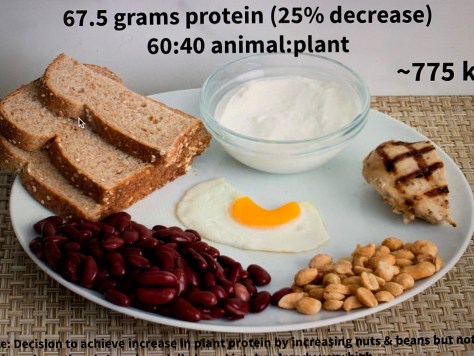
Note: Decision to achieve increase in plant protein by increasing nuts & beans but not bread was intentional.
American daily bread intake is already very high!
Protein Take Home Points:
- Reduce animal protein intake by 25%. It will still exceed RDA, since RDA has safety buffer.
- Shift food proportions from 85:15 animal to plant based ratio to 60:40 animal:plant ratio.
- Plant protein quality is higher than many people believe.
- Green house gas emissions decreases by 40% with a mere 25% decrease in animal protein intake.
- Americans (justifiably) confused about HOW MUCH protein they need, and from WHAT SOURCES to get it. In general, they get a LOT and a LOT MORE THAN THEY NEED.
- There is tremendous room for a substantial shift from animal to plant protein which can lead to environmental benefits and the added benefit of more fiber in our diet.
Sugar. Takeaway Points:
- There are natural sugar in vegetables and fruits. Americans have room to INCREASE natural sugar intake from vegetables and fruits which comes with the benefits of fiber and nutrients.
- Added sugar consumption levels are obscene in the U.S! The health impact = obesity and type 2 diabetes.
- The U.S. is the largest consumer of sweeteners including high-fructose corn syrup.
- Enjoy sugar in appropriate amounts but don’t abuse it.

All source material from Christopher Gardner’s presentation for Stanford Nutrition and Science.
For more information on how our food habits impact the environment take a look at this article from NYTimes Your questions about food and climate change answered. How to shop, cook and eat in a warming world.
And now here is this outstanding nutrient packed plant based lunch made with lots of quinoa, veggies and burrata cheese.
Quinoa Salad with Burrata Cheese
4 servings
Ingredients:
- 1 bag arugula or rocket greens. About 3 to 4 cups.
- Burrata cheese. They come in balls, and depending on the size, use one or two per plate.
- 1 cup cooked quinoa
- Sunflower seeds – 4 tbsp
- Balsamic vinaigrette or any dressing of your choice
- 1 bell pepper cut into thin strips
- 1 small onion finely cut
- 2 tomatoes cut into chunks
- 1 avocado cut into slices
- 1 small cucumber cut into chunks
- Any other veggies you want like broccoli, cauliflower, carrtos, etc.
Directions:
- In a large salad bowl place the cut onions first. Next add the tomatoes, peppers and avocado. Squeeze a little lemon juice over the avocado slices. Top the veggies with cooked quinoa and then the arugula leaves. Set aside until ready to serve.
- Right before serving, toss with sunflower seeds and balsamic dressing.
- Serve right away with a side of burrata cheese.


Eat a salad, boost brain power!
Eating a salad evey day keeps brains 11 years younger and prevents dimentia study shows.


